ANNOUNCEMENT
Dear colleagues,
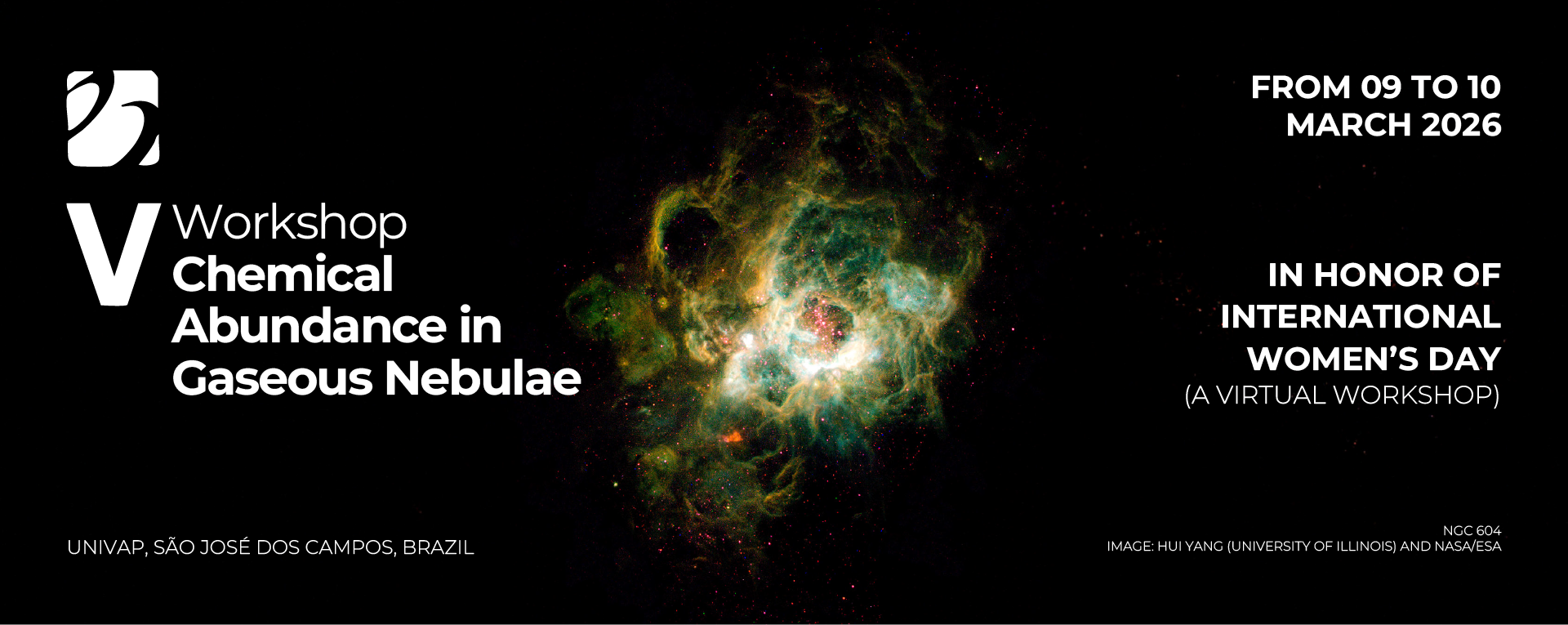
We are pleased to announce the V Workshop:
CHEMICAL ABUNDANCES IN GASEOUS NEBULAE: IN HONOR OF INTERNATIONAL WOMEN’S DAY
A workshop in honour of women studying chemical enrichment in gaseous nebulae and related fields.
This workshop will take place on 09 - 10 March 2026 and will be held online, virtually hosted by the Universidade do Vale do Paraiba, Sao Jose dos Campos, Brazil.
This year's edition of the "Chemical abundances in gaseous nebulae" workshop will explore the chemical universe in honour to those women who shaped this field. The work of Cecilia Payne a century ago and Beatrice Tinsley in the late 1970s have pioneered the fields of stellar chemical abundances and the chemical evolution of galaxies, including the chemical properties of stars and gas within and around galaxies. This has led to a wealth of subsequent work that has further developed these fields, often with women at the forefront, like Chiaki Kobayashi, Rosemary Wyse, Grażyna Stasińska, and many others. Gas is essential for the formation of stars. Metals are produced in stars and stellar phenomena. Stellar feedback then recycles these metals in the interstellar medium, and these can contribute to the composition of the new generation of stars. These processes work together to form empirical scaling relations like mass-metallicity, which were discovered, developed and championed by women like Christy Tremonti. This workshop highlights the roles of stars and gas, in all its multiple forms and phases, in the production and evolution of metals in galaxies, throughout cosmic time, and aims to honour the outstanding achievements of women in these fields.
This workshop aims at bringing together scientists of all genders and career stage to discuss about the crucial questions on chemical abundances in gaseous nebulae and related topics, the recent progress in the field and how next generation observing facilities (such as the James Webb Space Telescope, the Extremely Large Telescopes, and the Habitable Worlds Observatory) will enable major steps forward in this area of research.
RATIONALE
The determination of the abundance of heavy elements (e.g. O, N, S, Ar) in gaseous nebulae provide crucial information to study the history of star formation and chemical enrichment of galaxies and of the Universe. Despite recent spectroscopic observations and surveys (CALIFA, SDSS, MaNGA, MUSE, CHAOS, MOSDEF, and JADES, to cite a few) have provided significant advances in the knowledge of the chemical compositions of gaseous nebulae and their host galaxies, some key aspects in the study of these objects remain ill-defined.
In particular, the abundance discrepancy problem in HII regions and planetary nebulae, generally interpreted as caused by the presence of temperature fluctuations, puts under scrutiny the nebular abundance scale of the Milky Way and extragalactic objects. Moreover, the determination chemical abundances and ionisation correction factors, both local and at high-redshift, still suffer strong dependences on the photoionization conditions and on the different methods and models used for the analysis.
This 2-days workshop aims at bringing together scientists and students to extensively discuss about the crucial questions on chemical abundances in gaseous nebulae, the recent progress in the field and how next generation observing facilities (such as the James Webb Space Telescope and Extremely Large Telescopes) will enable major steps forward in this area of research.
ORGANIZERS
Annalisa De Cia (ESO, DE)
Guillermo Hägele (IALP, Argentina)
Karla Arellano-Cordova (UOE, UK)
Lucimara Pires Martins (UNICID, Brazil)
Monica Cardaci (IALP, Argentina)
Oli Dors (UNIVAP, BR)
Sophia Flury (UOE, UK)
PROGRAM AND SPEAKERS
Invited speakers:
● Floor Broekgaarden (U. California, San Diego, USA)
● Chiaki Kobayashi (U. Hertfordshire, UK)
● Francesca Matteucci (U. Trieste, Italy)
● Celine Peroux (European Southern Observatory, Garching, DE)
● Grace Telford (U. of Utah, USA)
● Elena Terlevich (INAOE, Mexico)
● Thaisa Storchi Bergmann (UFRGS, Brazil)
IMPORTANT DATES
Event:
From 09 to 10 March 2026
Abstract submission deadline:
13 February 2026
Registration deadline:
20 February 2026
CONTACT
nebulaeworshop@gmail.com
SPONSORS